

Clever air treatment with less energy
How clean is the air you breathe indoors? Rabih - CTO of Maxairea and regular attentdee to Fast Track's series of CTO Unconferences - shares the way Maxairea improves indoor air quality. Both online and in Delft, Rabih's open Lebanese background and energetic stance is disarming. The team - that includes Williamd an Marcel - is transforming ventilation with clever air care systems that capture CO₂, optimize airflow, and cut HVAC energy use. Their modular solution delivers fresher air, lower costs, and a smarter route to sustainable, Paris-proof buildings.
Tell us about Maxairea's mission.
Any given building used by human, needs a minimum level of fresh air for optimal human usage. Maxairea has developed innovative carbon capture solutions that optimizes the inflow of fresh, clean air into ventilation systems while it increases the energy performance of that system at the same time. We call it ‘clever air care systems. Our products use a combination of a CO2 filter, sensors, a heater and a valve to direct the air. Maxairea system leads up to ~30% HVAC energy savings (up to 15% whole-building), it’s a combination of hardware and software control.
Are you curious if your development question fits TNO Fast Track approach? Take the Quick Scan to find out
What makes your technological approach unique?
Getting indoor air quality right starts with the input. Current outdoor fresh air has a CO2 concentration of 420 PPM – the infamous carbon dioxide graph. The Maxairea clever air care system filters out CO2 concentration to less 100 PPM and passes on the air in the ventilation system. You can either add it to existing or new mechanical ventilation systems to optimize the performance of the system and the indoor air quality for human wellbeing. Indoor air quality is based on the following parameters:
- Indoor temperature
- Relative humidity
- Particular matters (dust)
- TVOC (total volatile organic compound)
- The CO2 level
The parameters should be within certain rangers. You probably have experienced some decline of human comfort when you were in a room or building in which the parameters were not well balanced.
Did you know we spent about 90% of our time as human beings indoor?
It’s about optimizing the indoor air quality to optimize the human performance (production, cognitive function, etc.) in buildings, while lowering the energy demand and its related cost.
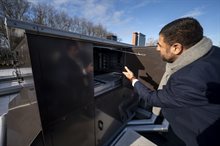
The Maxairea is designed from a modular perspective so that it can added or installed to any existing mechanical ventilation system. This enables us to develop products can be used as stand-alone products within specific rooms or integrated into full air handling units. For monumental buildings for example, the stand-alone products are best suited, while for large office and hotels buildings we offer the Maxairea clever air care add-on.
At the moment, there is no regenerative filter that can be added seamlessly to existing or new mechanical ventilation system. The filter is really the unique part of our technology; other parts are of the shelf components. The filter holds the CO2 and releases it when heated. You use the filter for 3000 cycles of holding and releasing CO2. That’s approximately 10 years if you use the filter once per day.
What is the societal relevance of your technological approach?
Buildings – from construction to operation - are a massive consumer of energy and contributor to CO2 emission. This is changing due to government regulation and financial incentives.
One the one hand, building owners need to comply to these new government regulations. The regulation (office building minimum energy label regulation). On the other hand, evaluation reports of banks take the building energy label into account when establishing the value to their assets. If a building has an energy label <C for example, it is worth less. It makes commercial sense for both buildings owners to improve the energy label and get to ‘Paris proof’ real estate. That is why building owners are investing in optimizing their assets.
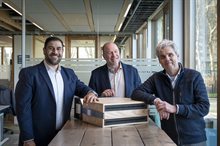
These two factors make that building owners are in search of solutions Maxairea is developing. Specially that disturbance to tenant in existing building is minimal – no major construction work is needed, all the work is done in the technical room. At Maxairea we believe that we are well positioned to be successful, among others because the payback time of our system is less than 5 years. It is a no-brainer for real-estate asset owners, hotel chains and installation companies to improve the ventilation systems. Especially in the Netherlands where energy is relatively expensive with 0,28€ per Kw/h. Payback time for a hotel is less than 2 years because the building is used 24/7 and the building operational costs will go down.
How did you get in touch with TNO Fast Track?
We met Ruben Brinckmann at Hello Tomorrow in Paris in 2025 at the Discover Dutch Deeptech stand. I told him about the story of Maxairea and the project at The Green Village in Delft. The BK Launch brought us in contact to InnovationQuarter resulting in the project with The Green Village.
How has TNO helped along the way?
We wanted a third party to validate our technological claims throughout with the data that we are measuring in The Green Village. After meeting Ruben in Paris, we sat down together to discuss the project. Ruben was able to connects us with the appropriate scientist – in our case Piet Jacobs. As we wanted to be listed on EIA list of RVO - a list holds solutions to save energy in buildings – independent, high-quality, third party validation of the data points is crucial. Piet Jacobs was able to assess the infrastructure of our measurement system. It is important that the data we are harvesting is accurate and reflecting reality.
How would you describe the business relevance of the support you received?
Making sure that there are no unknows is crucial for startups. We do not want to miss an unturned stone as we are in the phase of pilot projects. We want to make sure that we learn as much as possible now, before we enter series production. Our goal is to leverage this phase by getting all the relevant partners and knowledge on board.
To make it concrete, we will test, measure, and validate our positive impact on indoor air quality and energy consumption. The Green Village provides and facilitates all technical requirements, in collaboration with Orange Climate (with special thanks to Bert van Dorp for his multi-channel support to Maxairea), Van Dorp Installatie, and PRIVA. All energy and indoor air quality data will be monitored through the PRIVA portal to ensure accurate assessment of both indoor air qualitt improvements and energy efficiency. For us, this collaboration helps in derisking and condifence building.
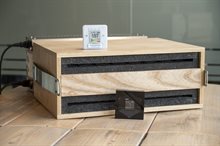
In parallel, as we are experiencing market traction, we have onboarded a production engineer with over 30 years of experience that helps us to build a blueprint for production. This enables us to debug and derisk our plans while leveraging existing manufacturing systems. One of the options we are exploring is finding a production partner within the Benelux to license our system.
How do you look back at TNO’s support?
What I really appreciated is the direct approach. We dived right into it. This started with the very first conversation I had with Ruben in Paris. It took us three weeks after our initial contact in Paris to kickstart the project (which will last about 1 year) with Piet Jacobs. We wanted to have the best party on board with the highest reputation, and in a matter of weeks we literally ‘fast tracked’ the whole project. We will be experimenting the different seasons of the Dutch weather on our systems.
About TNO Fast Track
Do you have a challenge where you could use TNO’s specialized knowledge and R&D? Through TNO Fast Track, we are your independent technology partner for startups, scale-ups, and innovative SMEs. Schedule an intake with TNO Fast Track, and we’ll get in touch quickly to accelerate your innovation together.